

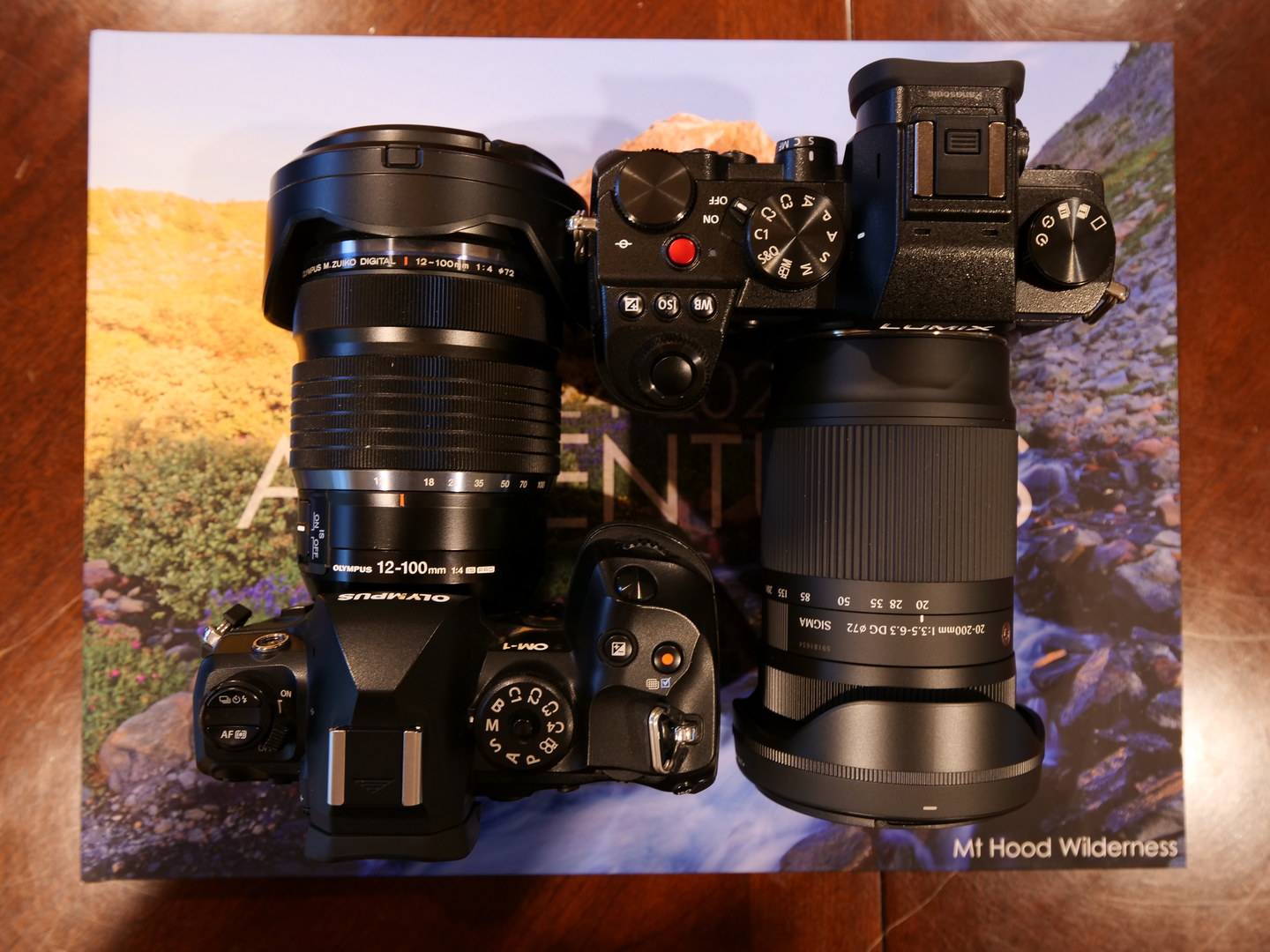
Sigma 20-200 vs Olympus 12-100
I’ve owned the Olympus 12-100 F/4 PRO lens twice during two separate ventures into the M43 system. The first time, back in 2019, I acquired the lens as part of a trade. I was in the process of moving off M43 to Sony at the time, so I didn’t hang on to it or really give the lens a lot of use. When I got back into M43 to build a small kit for longer, more challenging hikes I decided to buy it once again to give it a go. I found that it made an excellent companion for long treks up mountain sides offering the ability to capture far away subjects like distant peaks or even larger wildlife all the way to wide vistas while never missing a shot. This wasn’t a new capability, superzooms have existed a long time. What made the 12-100 special was the famous Olympus weather sealing, the Dual IS capability for long hand held exposures (especially leveraiging LiveND) and excellent image quality throughout the entire zoom range.
Speaking of the image quality, when I purchased my current copy of the 12-100 I also had a Sony a7r2 with a tamron 28-200. That Tamron lens, when released, was hailed as the superzoom done right. I read many reviews suggesting that lens had largel eliminated the optical compromises that usually came with a superzoom, while also offering up f/2.8 on the wide end which was a game changer for an all rounder. I put that lens which I had used for a while against my Olympus 12-100 and in my testing the Olympus not only held up from 28-50mm, but pulled well ahead the further past 50mm (25mm on the olympus) I went. This led me to sell the Tamron and stick with the much better Olympus. The Olympus also offered me the ability to hand hold much longer exposures and use the other computational modes I had come to appreciate. Compared with other high quality lenses I own, the 12-100 generally compared well, especially when you consider it’s range. It performs comparably fo my 40-150 f/4 PRO, or my previous 12-40 f/2.8 PRO lenses while offering the nearly the coverage of both those lenses.
Enter the Sigma 20-200
So when the Sigma 20-200 was released and I looked at the specs I expected it would likely be reasonable from 20-50, then slowly fall apart. Reviews did suggest, however, that it was optically pretty good. Even wide open it seemed pretty good with stopping down showing only modest improvemnets (mainly in corners). So I wondered how it would fare against the Olympus 12-100. No such comparison seemed to exist, so I bought a 20-200 myself to compare. The thought of a lens the same size with an even wider field of view is enticing.
Size, Build Quality, Specs

When collapsed the two lenses are nearly the same length (the Sigma is 1mm shorter). The Sigma is visibly narrower. The Olympus is 561 grams, the Sigma is 550 grams.

When fully extended, the Sigma is slightly longer. So take your choice - a narrower lens or one that is slightly shorter fully extended. Considering the Sigma covers more effective focal range and a larger image circle, the size is impressive. Normally I would expect this to come at the expense of optical quality but reviews I had already seen suggested otherwise.
In terms of build quality, both are all metal construction. The OM has an IP53 rating, though, and the Sigma is splash and dust resistant with no IP rating.
The Sigma zoom ring is fairly stiff, particularly at the wide end. This is not an issue for me, but something to know. The Olympus turns very easily, but is not so loose as to be concerned about creep while doing something like a long time lapse.
The sigma does not offer any stabilization. That said most of my shots with my 12-100 are at shutter speeds 1/4" or faster and until now I’ve had very good (near 100%) success with Lumix full frame IBIS at 1/4" and faster shutter speeds.
Image Quality
Testing methodology is as follows:
- 12-100 is mounted to an OM System OM-1
- 20-200 is mounted to a Lumix S5
- Both are in manual mode
- Both on a tripod
- Stabilization off
- 2 Second shutter delay
- S-AF, with AF point in the center
- Two photos per focal length and perture were taken to ensure sharpness
- auto white balance (i’m not evaluating lens color rendering)
- Sharpness is coampred from OOC JPEGs, which have default amounts of sharpening applied. This is partially becuase my RAW processor (dxo Photolab 8) does not have a profile for the L-Mount Sigma yet.
For each focal length I shot both wide open, then at f/5.6 and f/8 respectively to compare sharpness stopped down. I have observed previously that the 12-100 is sharpest at f/5.6, and I assume the Sigma will be sharpest around f/8 (and f/8-f/11 is where I mostly shoot landscapes).
Exposures are not quite identical. I did not compensate for shutter speed differences needed to address the base ISO gap of the cameras (200 vs. 100).
20mm
The Olympus starts at 24mm equivalent, so comparing the Sigma at 20mm is not really feasible. That said, here is a comparison of the field of view of 20mm on a 3:2 sensor versus 12mm on 4:3. For wide landscape shots the 20mm 3:2 does offer a unique advantage, especially if you are framing a shot for 16:9 cropping. In this case the 20mm on 3:2 ends up being more like a 9mm on M43 if you are mostly interested in fitting a scene horizontally in the frame versus vertical elements. For landscapes I often frame 16:9 for desktop wallpaper use. The idea of an M43 9-100mm f/4 lens would be something!
24mm (12mm) Comparison
Starting at 24mm, the Sigma is alredy past it’s widest point, and this is probably an advantage in terms of sharpness. But let’s see…

Above: Center 24mm (Left) and 12mm (Right) wide open

Above: Corners 24mm (Left) and 12mm (Right) wide open
The Sigma is at f/3.9 at 24mm (starting at f/3.5 at 20mm). I expected at this wide of an angle with what would be f/1.95 on an M43 mount to see some softness from corners just being out of focus due to field curvature. But the center and corners are already sharp. It’ shard to pick a winner here and I would say at 24mm/12mm it’s a tie wide open.
Stopping down to f/8 it’s a similar story. Both are very sharp and I think there is an ever so slight perceived advantage to the Sigma that I would attribute to simply having extra megapixels in the image.
Above: Above: Center 24mm f/8(Left) and 12mm f/5.6(Right). Above: Above: Corners 24mm f/8 (Left) and 12mm f/5.6 (Right).

35mm (18mm) Comparison
Coming to 35mm things change a bit. Wide open the Sigma has an advantage in both the center and corners.
Above: Above: Center 35mm (Left) and 18mm (Right) wide open. Above: Above: Corners 35mm (Left) and 18mm (Right) wide open.

The advantage continues when both are stopped down to f/5.6 and f/8 respectively, although the Olympus closes the gap slightly.
Above: Above: Center 35mm f/8(Left) and 18mm f/5.6(Right). Above: Above: Corners 35mm f/8(Left) and 18mm f/5.6(Right).

50mm (25mm) Comparison
25mm (50mm equivalent) is where the 12-100 has historically starts really pulling ahead of other lower quality zoom lenses. The kit zooms, the 14-150 and 14-140s of the M43 world (I have had the Olympus 14-150 ii, Tamron 14-150 for M43, and a Lumix 14-140), and my former Tamron 28-200 etc.
But this is interesting, wide open the Tamron is sharper in both center and corners.
Above: Above: Center 50mm (Left) and 25mm (Right) wide open. Above: Above: Corners 50mm (Left) and 25mm (Right) wide open.

Stopped down the 12-100 does improve, but the Sigma advantage continues.
Above: Above: Center 50mm f/8 (Left) and 25mm f/5.6 (Right). Above: Above: Corners 50mm f/8 (Left) and 25mm f/5.6 (Right).

85mm, 105mm, 135mm
I planned to add images of 85mm, 105mm and 135mm focal lengths, but this small lead of the Sigma continues throughout all those focal lengths. Generally the best corner of the Sigma is a smidge better, and comapring even the worst corner of the two the Sigma is still a smidge better in every focal length and aperture.
200mm (100mm) Comparison
So the Sigma, starting at 20mm, must fall apart by 200mm, right? This was my assumption before I even bought the lens and I assumed I would likely be returning it with the 12-100 matching it at most other focal lengths, but easily besting it at 100mm. Even compared to my 40-150mm F/4 PRO lens the 12-100 is great at 100mm. Well, let’s see…
Starting wide open, the two seem to be neck and neck int he center on initial glance. However, this is a small hair/fiber just to the right of the circls in the center of the test chart that the Sigma is resolving nicely showing better contrast/detail.

Above: Above: Center 200mm (Left) and 100mm (Right) wide open.
Moving to the corners and both are doing well still, except the 12-100 becomes fairly soft in the extreme corner of the frame.

Above: Above: Corners 200mm (Left) and 100mm (Right) wide open.
Stopping down to f/8 and f/5.6 respectively and the centers remain sharp, with the corners on the Sigma not really appearing to improve any. In spite of the 12-100 seeing improvements in the corners, the extreme corners of the Sigma are still a tad sharper.
Above: Above: Center 200mm f/8(Left) and 100mm f/5.6 (Right). Above: Above: Corners 200mm f/8(Left) and 100mm f/5.6 (Right).

At 100mm I would argue that sharpness in extreme corners is not that important. Generally at that focal length I am zooming in on a specific subject, such as an animal or person I’m hiking with, and the corners are not going to be in focus anyways. Starting around 50mm in fact this is often the case. The exception for me at least would be zooming in towards distant mountains where I would still desire sharper corners. Even then some softness in the extreme corners would not be a deal breaker.
Summary and Final Thoughts
The Olympus 12-100 was a revolutionary lens when it came out. I have read comments in forums on people who shoot M43 because of that lens and the flexibility it offers. Before the Sigma the only way to match it on full frame was to carry a veyr heavy 24-105 F/4 lens and then an additional zoom like a 70-200 f/4, or maybe a 70-300 variable aperture lens. The full frame would be a much larger kit and require lens swaps. That said, a high resolution full frame sensor would offer some additional cropping at 200mm, but that extra reach from cropping is not a big enough benefit to warrant carrying the gear and dealing with lens swapping.
The Sigma has clearly addressed this gap for the mounts it is available for (Sony E and L Mount) while also offering a unique advantage in starting at 20mm.
So should you abandon your 12-100 and switch systems? I do not think the Sigma warrants switching systems and would not advocate anyone using M43 and the 12-100 sell their gear and switch. There are of course numerous other considerations such as overall system size (where M43 still leads), computational features, class leading stabilization, overall system cost etc. While full frame does seem to be slowly closing all these gaps with smaller lenses, better IBIS, more third party affordable lenses (like this Sigma) M43 still offers, in my view, a unique proposition that fills certain niches.
I already shoot dual systems (Lumix FF and M43) for specific use cases. My FF setup has been primarily used for low light shooting, night sky/astro shots and anywhere I want more resolution (with my S1R). Already owning an S5 though, this Sigma lens allows me to swap my 12-100 for a wider angle, slightly better corner sharpness and more resolution all without sacrificing anything in terms of overall size/weight.